
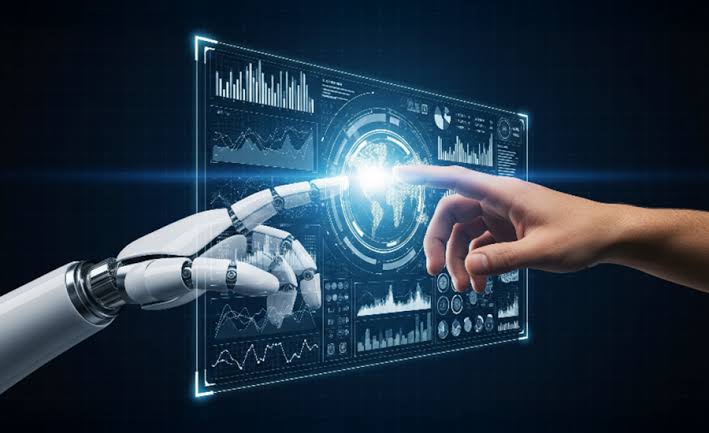
Imagine a workplace where routine paperwork is completed before the morning meeting, machines identify faults before they cause expensive downtime, and customers receive useful answers without waiting in a queue. This is no longer a distant vision of the future. Artificial intelligence and automation are steadily changing how organisations operate, compete, and deliver value across industries.
What makes this transformation significant is not simply the arrival of more sophisticated software or machines. AI and automation are changing how people make decisions, allocate resources, manage risk, and perform everyday tasks. From factories and hospitals to financial institutions and logistics networks, businesses are discovering that technology can reshape entire processes rather than merely speed up individual activities.
AI Is Changing the Way Businesses Make Decisions
One of the most important contributions of AI is its ability to process large volumes of information quickly. Businesses routinely generate data from customer interactions, transactions, machinery, websites, supply chains, and internal systems. Traditionally, turning this information into useful insight required considerable manual analysis. AI can identify patterns and relationships that might otherwise take teams much longer to uncover.
This capability is particularly useful for forecasting and planning. Retailers can analyse purchasing behaviour to improve inventory decisions, manufacturers can anticipate equipment maintenance requirements, and transportation companies can adjust routes according to changing conditions. The technology does not eliminate the need for human judgment. Instead, it gives decision-makers more information with which to evaluate choices, while leaving accountability and strategic direction with people.
The growing adoption of AI also demonstrates why organisations need to approach automation thoughtfully. Institutions such as the OECD, World Economic Forum, and International Labour Organisation have emphasised that technological change affects both productivity and the nature of work. Successful implementation therefore involves more than purchasing new software. Employees need appropriate training, organisations need reliable data, and leaders must establish safeguards around privacy, security, accuracy, and responsible use.
Automation Is Reshaping Manufacturing and Logistics
Manufacturing provides one of the clearest examples of automation’s practical impact. Modern production environments can use robots, sensors, computer vision, and predictive systems to perform repetitive activities while monitoring production quality. Automated equipment can operate with consistent precision, helping companies reduce avoidable errors and respond more efficiently to changing production requirements.
Logistics is experiencing a similar transformation. Warehouses increasingly use automated systems to sort, move, and track goods, while AI can support demand forecasting and route planning. These improvements matter because even a small inefficiency can become expensive when multiplied across thousands of shipments. Better coordination can help organisations use storage capacity, transportation resources, and employee time more effectively.
However, automation does not necessarily mean replacing every human role. In many workplaces, technology changes what employees spend their time doing. Instead of manually checking every item, workers may supervise automated quality-control systems and investigate exceptions. Instead of entering repetitive information, administrative staff can focus more heavily on communication, problem-solving, and tasks requiring contextual judgment. This shift makes reskilling increasingly important as organisations introduce new technologies.
Financial Services Are Becoming More Technology Driven
The financial sector is another area where AI and automation are having a substantial influence. Banks, investment firms, insurers, and other financial organisations process enormous quantities of information every day. Automated systems can help identify unusual transactions, support customer service, organise documents, and analyse financial information.
Automation is also changing how individuals interact with financial markets. Investors can access research tools, portfolio information, market data, and educational resources through digital platforms that would once have required substantial institutional infrastructure. At the same time, technology has made it easier to explore different asset classes and understand how they may fit into a broader financial strategy.
For example, someone researching equities might encounter terms such as ONDS stock while exploring market-related information and need to distinguish between different financial instruments, terminology, and potential risks. This highlights an important point: easier access to information does not automatically make financial decisions easier. Investors still need to understand volatility, diversification, fees, liquidity, taxation, and their own objectives before acting. Automation can support analysis, but it should not replace informed judgment.
Healthcare and Professional Services Are Evolving
Healthcare is also adopting AI and automation, although the stakes make careful implementation especially important. Technology can assist with administrative work, appointment management, medical documentation, image analysis, and the organisation of patient information. Reducing unnecessary administrative workloads may allow professionals to devote more attention to direct patient care.
The same principle applies to professional services. Legal teams, accountants, consultants, engineers, and other specialists increasingly use AI-assisted tools to search documents, summarise information, identify patterns, and handle repetitive workflows. These applications can save time, but professionals remain responsible for checking outputs and applying expertise to situations where context matters.
Conclusion
AI and automation are transforming industries because they change more than individual tasks. They influence how businesses analyse information, manufacture products, move goods, serve customers, manage finances, and organise professional work. The most meaningful benefits emerge when technology is introduced to solve genuine operational problems rather than adopted simply because it is new.
For individuals and organisations alike, adaptability will be one of the defining advantages of the coming years. AI can provide speed, scale, and analytical capability, while people contribute judgment, creativity, responsibility, and understanding.